Creators · Model Watch
UniMate wants one animation model to move almost any rig
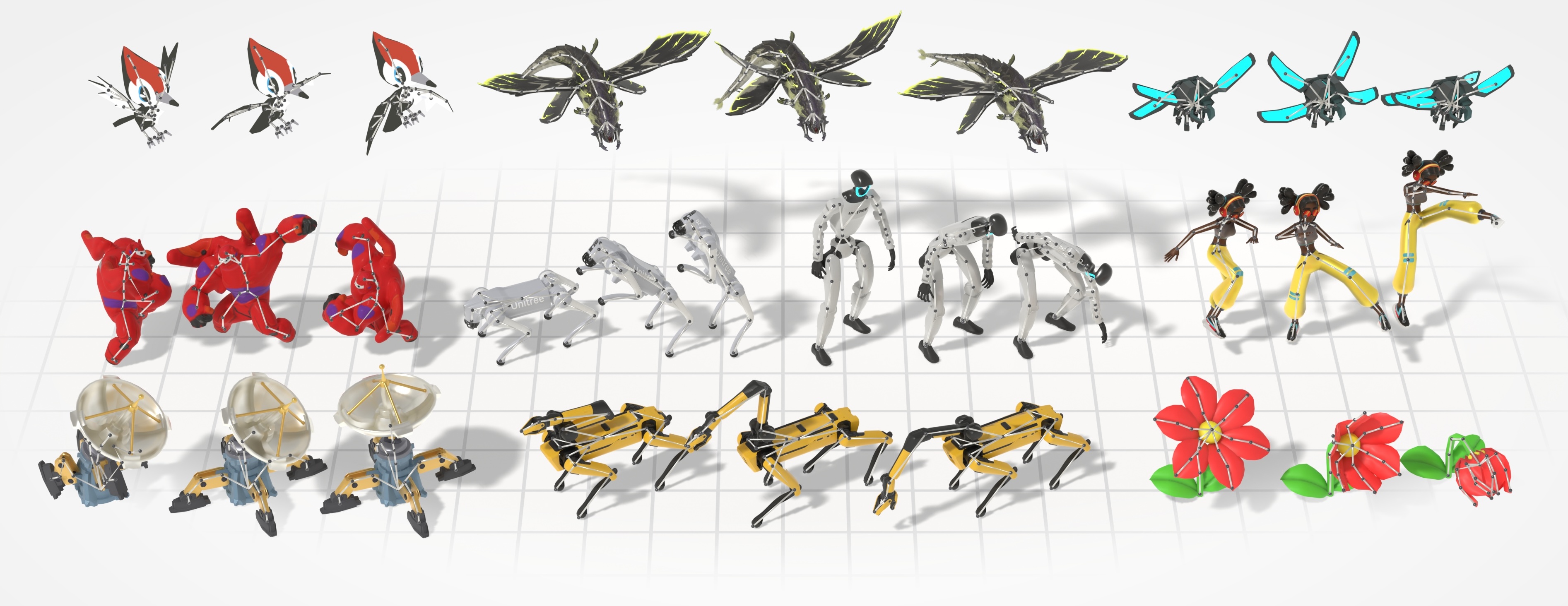
Give it a rigged asset and a text prompt, and UniMate can generate motion across radically different skeletons without training a new model for each one.
Reporting updated Oct 1, 2026
THE TAKEAWAY
Generating a 3D character is getting easier. Animating that character is still hard. UniMate attacks that problem with one model designed to understand humans, animals, insects, serpentine creatures and articulated objects without retraining for every rig.
The skeleton can change. The model doesn’t have to.
Most animation systems make assumptions about the character they need to move.
A human skeleton looks one way. A dog, bird or dragon may look completely different.
UniMate takes a rigged 3D asset plus a text prompt and generates motion based on the structure of that specific skeleton.
No separate model for the dog.
No separate model for the human.
No per-skeleton retraining every time the creator introduces something unusual.
This is a major 3D bottleneck
AI-generated 3D has improved quickly.
A small team can increasingly generate a mesh, texture it and rig it faster than before.
It can edit motion too
Then it has to move.
A creature needs locomotion. A boss needs attacks. A strange skeleton may not fit the animation library the team already owns.
That is where production gets expensive again.
UniMate is not limited to prompt-to-animation.
It can generate movement between starting and ending poses, keep part of an animation fixed while regenerating another section, and extend existing motion with additional prompts.
Those tools begin to look less like clip generation and more like animation editing.
This is still research.
Game-ready motion has to survive contact, foot sliding, retargeting, gameplay timing and art direction.
The immediate story is not that animation has been solved.
It is that one of the hardest parts of generative 3D is starting to get the same general-purpose model treatment already happening in images, video and geometry.
THREE THINGS THAT MATTER
One model
The same pretrained system works across different skeleton topologies.
13,006 motions
Its UniML3D dataset spans bipeds, quadrupeds, birds, marine creatures, insects and more.
More than generation
UniMate also supports motion editing, in-betweening and extension.
“Generating the character is only half the job. The real production problem starts when everything you generate needs its own motion.”
VEYR Editorial
What VEYR is watching
As creators gain more freedom in what they can generate, they will need animation systems capable of moving whatever they invent.
That is what makes UniMate worth watching.