Games · News
AnyGameRenderer turns gray-box games into new worlds while keeping the action in place
Alaya Lab's video-to-video research takes primitive gameplay footage and reimagines its appearance, while measuring whether characters and objects remain where the game put them.
Reporting updated Oct 26, 2026

THE TAKEAWAY
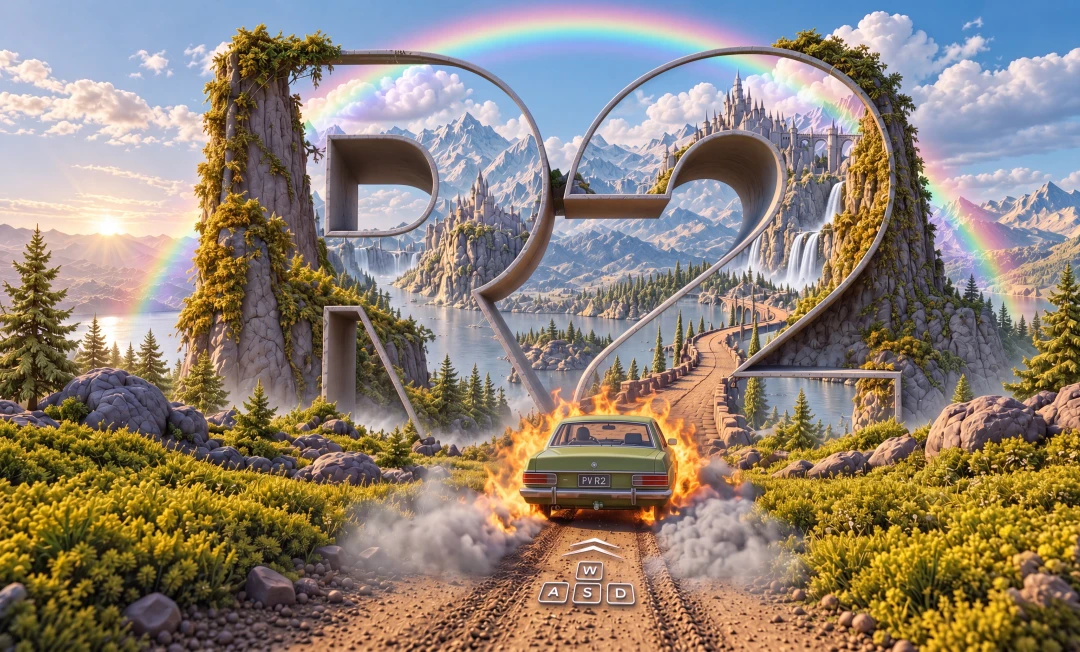
Imagine recording a game built from gray blocks, colored cylinders and flat surfaces. Now imagine turning that recording into a fantasy battlefield or a science-fiction shooter without changing where the enemies stand, when characters move or how the camera travels. That is the idea behind AnyGameRenderer, a research project from Alaya Lab.
WHAT HAPPENED
Researchers Ruicong Liu, Liangyang Ouyang, Fengbo Lan, Zhixiang Wang and Kaipeng Zhang introduced AnyGameRenderer on October 22.
The system uses a LoRA fine-tune of MiniMax-H3 Ref2VA to transform rough gameplay footage into a prompted visual style.
It works from video rather than requiring direct access to a game's engine, object labels or detailed geometry.
The examples span shooters, racers, survivor games, vehicle combat and other genres.
What distinguishes the project is its focus on preserving the identity and timing of objects while changing their appearance.
WHY IT MATTERS
A small team may have a working game long before it has the time or money to produce polished artwork.
AnyGameRenderer suggests a way to explore visual directions using existing gameplay, rather than rebuilding the game for every art-direction experiment.
The researchers report an improvement in temporal entity matching from 50.9% to 62.9% against their base model.
That is meaningful progress, but it is not perfect preservation. Their reported hallucination rate remains 46%.
There is also a substantial technical barrier: the published setup calls for an 80 GB-class GPU, at least 128 GB of system RAM and approximately 123 GB of base model weights. A short rendered example takes about 17 minutes on H100-class hardware, excluding model loading.
This is a research workflow, not a realtime game renderer.
FOUR ELEMENTS OF THE WORKFLOW
Primitive gameplay
Start with a recorded game using simplified objects and environments.
Style instructions
Describe the desired setting, subjects and visual treatment.
Generative rendering
The model converts the footage into a richer-looking world.
Entity testing
The researchers measure whether objects remain present, correctly positioned and consistent over time.
The real achievement would be changing everything about how a game looks without changing what the player actually did.
VEYR ANGLE
For independent creators, the exciting possibility is faster visual exploration.
A designer could prototype a mechanic first, record it and experiment with several visual identities before committing to an asset-production pipeline.
The next challenge is consistency. A beautiful re-render is useful for look development, but game production needs repeatable, editable and dependable results.