Tools · News
Model Wars: Astra vs. Opus 5.5 needs a better 3D test
Peter Yang’s coded Golden Gate Bridge puts Opus 5.5 in the conversation. Choosing a model for production takes more than an impressive first view.
Reporting updated Sep 23, 2026
KEY TAKEAWAYS
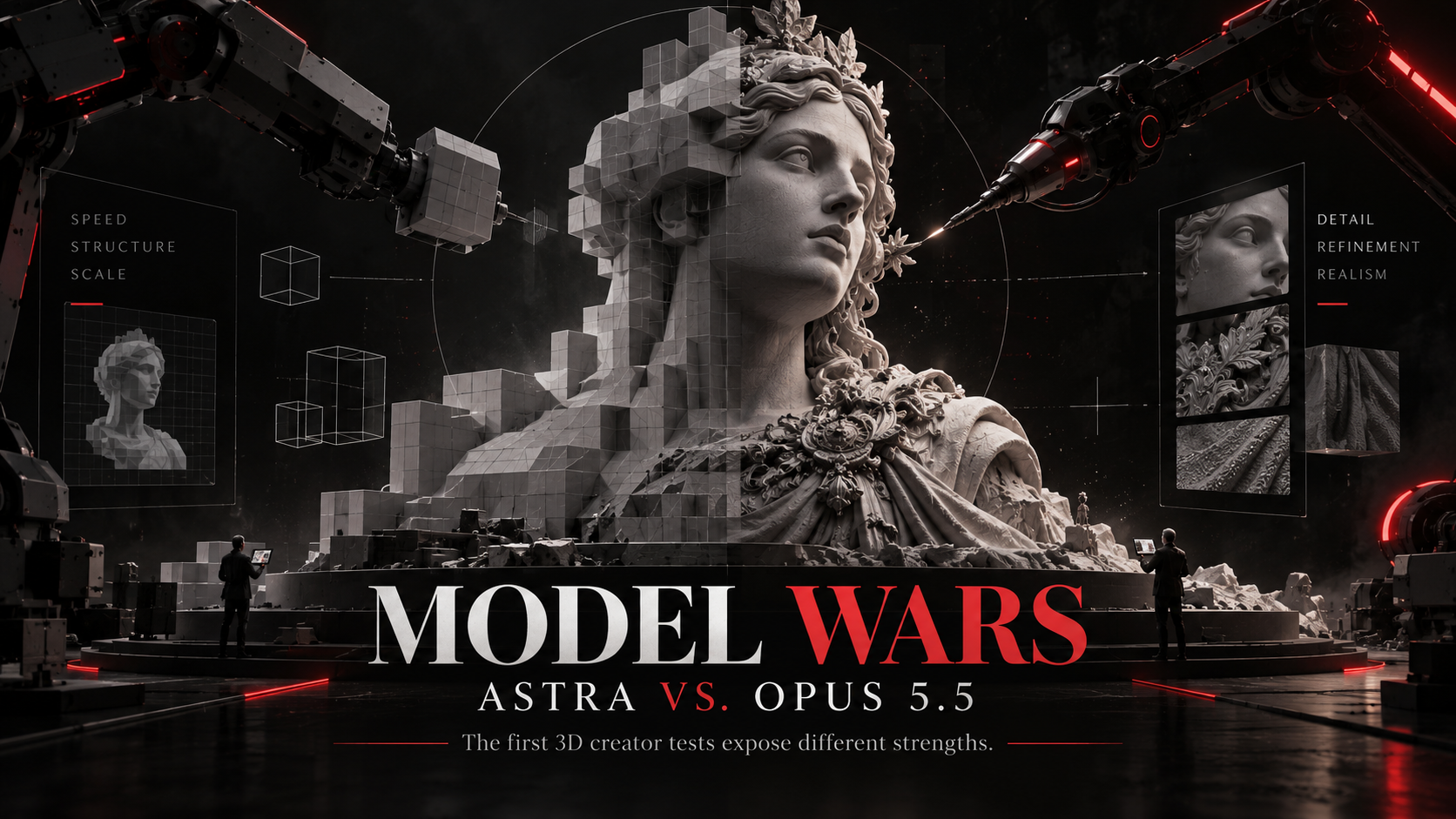
Peter Yang rates Opus 5.5 alongside Astra for 3D scenes in his own tests. VEYR has not reproduced that comparison.
A separate Blender car test reports different speeds and detail, but its model version and settings prevent a fair Astra–Opus 5.5 verdict.
For a small team, the useful finish line is a scene that survives feedback without hours of repairs.
What Happened
Peter Yang says Claude Opus 5.5 built his Golden Gate Bridge scene entirely with code. In his tests, he puts it alongside Astra for 3D scene building. That gives creators a reason to try both. It also leaves a practical question: which one will need less work when the director asks for a change?
Anthropic released Opus 5.5 on September 22, emphasizing coding, longer tasks and lower costs than Opus 5. OpenAI’s Astra announcement highlights software engineering and computer use, with Blender and Unreal Engine demonstrations. Those capabilities could help creators build scenes through instructions and code. The companies’ demonstrations do not settle how the models compare on the same creative job.
Look past the first camera angle
Yang names the model behind his bridge and links to a video comparing it with Astra. His verdict is useful as a creator’s assessment. His post does not tell us whether both models received identical follow-up instructions, took the same time or left equally editable files. VEYR has not reproduced his run.
For an early shot discussion, a convincing view may be enough. A scene that needs a moving camera has a harder job: its proportions and connections must hold up from other angles. A requested change should also preserve the parts already approved. Those are the checks we would make before treating an impressive demonstration as a production shortcut.
The car test comes with an asterisk
In a Reddit comparison, Big-Sandwich733 says Astra and Opus received the same Nissan Skyline prompt in Blender. The creator reports roughly half an hour for Astra and an hour and a half for Opus, while preferring detail in Opus’s paintwork. They describe modeling with Python in Blender and inspecting the result in Three.js.
The settings complicate that result. In a reply, the author says Opus ran at xhigh effort and Astra at high. The thread also fails to establish the exact Opus version reliably. We cannot turn those timings into a claim that Astra is three times faster than Opus 5.5. The example does show why a shared prompt is only the start of a fair comparison: readers need the model and settings too.
Make the second request part of the test
For VEYR’s proposed comparison, both models would build a small scene with relationships we can inspect. Put a vehicle inside a marked parking space, keep its wheels on the ground and place another object behind it. That would test spatial decisions alongside the appearance of the render.
Then change the brief: move the camera, widen the space and replace one material. Check what breaks and count the corrections. Open the saved Blender project or run the scene’s source again. A finished video alone cannot tell a creator whether the underlying work is usable.
The clock should keep running through revisions, repairs and handoff. We would record the model identifier, effort setting, tool access and spending limit. A fast first attempt is helpful; a scene that takes longer to repair may still leave the team worse off.
Why It Matters
A small team needs fewer hours of repairs after feedback. A model that handles a second camera angle or a material change cleanly could save a creator another evening rebuilding the scene. The bridge and car examples make that worth investigating, but neither tells us how much time a different team would save. Someone still has to inspect the project and approve the shot.
What VEYR Is Watching
Yang gives Opus 5.5 a credible place on the test list for coded scenes. Astra’s official demonstrations make Blender and engine work worth examining too. There is no overall winner in this evidence, and no reliable basis yet for assigning one model the speed crown and the other the detail crown.
Model Wars should follow the work past the reveal. Our next test would publish the prompts, settings, permitted project files and repairs required, so readers can judge what they could actually reuse. The result that matters is the scene a creator can keep working on.